 πλέγμα κατασκευασμένο

n the fields of river management and bank slope protection, how to balance structural safety with ecological friendliness has always been a core challenge for engineers. Gabion—a flexible engineering structure consisting of metal mesh cages filled with stone—is becoming an indispensable revetment solution in hydraulic engineering, thanks to its unique technical advantages.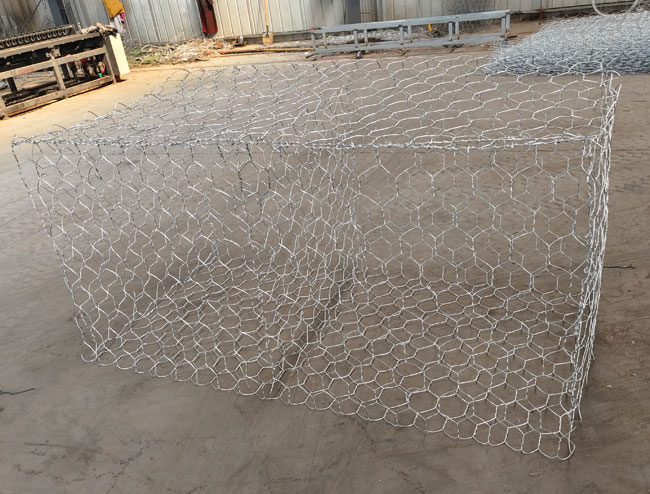
What Does “Εύκαμπτος” Revetment Mean?
Traditional rigid revetment structures (such as concrete retaining walls and mortared block stone) rely on their own weight and strength to resist external forces, lacking the ability to accommodate deformation. Once differential settlement occurs in the foundation or significant water pressure builds up, these structures are prone to cracking, overturning, or even complete failure.
Gabion structures are fundamentally different. Their flexibility is embodied in three key aspects:
-
Self-adaptive deformation: Gabion cages are connected by twisted steel wires, allowing relative displacement between individual units. This enables the structure to accommodate foundation settlement and bank creep without overall failure.
-
Self-adjusting stability: Under external forces, gabion structures can redistribute internal stresses through micro-adjustments of the stone fill, reaching a new equilibrium state.
-
Structural integrity: The double-twisted weaving process ensures that even if a steel wire breaks locally, the mesh will not unravel extensively, and the structural integrity remains intact.
This inherent flexibility makes gabions particularly suitable for riverbank sections with complex geological conditions and a high risk of differential settlement.
Core Applications in Hydraulic Engineering
The application of gabions in the water sector spans multiple areas, from river training to flood emergency response:
1. Riverbank Revetment and Levee Reinforcement
Gabions are commonly laid along riverbank slopes to resist flow scour and maintain slope stability. Even in channels with flow velocities up to 6 m/s, gabion structures maintain effective protection. For concave banks heavily scoured by floods, gabion structures effectively reduce direct flow impact on the toe of the slope.
2. Flood Emergency Response and Relief Works
Gabions offer significant advantages in emergency operations during flood seasons due to their ease of construction and ability to utilize locally available materials. Compared with concrete structures that require complex formwork and curing periods, gabions can be quickly assembled, filled, and closed, dramatically shortening construction time. Gabions have played a critical role in the management of the Yangtze River embankments and the Yellow River dangerous sections.
3. Dam Closure and Cofferdam Works
In hydropower project construction, gabion cages are used as closure dumping materials. Their heavy weight and strong integrity make them resistant to being washed away by high-velocity flow, significantly improving the success rate of closure operations.
4. Culvert Inlet/Outlet and Drop Structure Energy Dissipation
Gabions can be applied to the paving of culvert inlets and outlets, as well as the energy dissipation sections of drop structures. Their permeability helps reduce scour damage to downstream riverbeds caused by flow kinetic energy.
Key Advantages in Hydraulic Scenarios
Superior Scour Resistance
Gabion structures withstand high-velocity flow impact without displacement or damage. When flow encounters a gabion surface, part of the water seeps through the stone voids into the cage interior, reducing surface flow velocity while simultaneously lowering the direct drag force exerted by the water.
Excellent Pressure Relief Through Permeability
Unlike solid revetments, gabion structures do not have a sealed solid face. As water levels fluctuate, groundwater can freely pass through the stone voids and connect with the river water, effectively eliminating hydrostatic pressure behind the wall. This characteristic fundamentally prevents revetment sliding or overturning caused by pressure buildup.
Superior Freeze-Thaw Performance
In cold northern regions, traditional rigid lined channels often suffer damage from frost heave. The flexible nature and high porosity of gabion structures effectively dissipate frost heave forces. After repeated freeze-thaw cycles, the revetment remains stable—offering significantly longer service life and better protective performance than rigid alternatives.
Ideal Ecological Friendliness
The voids between stones in gabion structures provide habitat spaces for aquatic plants and benthic organisms. As sediment accumulates, vegetation grows naturally, forming a composite system of “engineered + ecological” slope protection. Gabion revetments fulfill protective functions while maintaining the connectivity of river ecosystems.
Technical Considerations and Quality Control
When applying gabions in hydraulic engineering, special attention should be paid to the following technical aspects:
-
Material selection: Mesh wire should be made of high-corrosion-resistance coated steel wire. For river projects, zinc-5% aluminum-mixed rare earth alloy coated steel wire is commonly recommended, offering significantly longer service life than conventional galvanized products. In compliance with GB/T 20492 standards, this material ensures no corrosion-induced fracture occurs within the design service life.
-
Μέγεθος πλέγματος: Select appropriate mesh openings based on the size of the stone fill to ensure no stone loss. Hydraulic engineering commonly uses mesh openings ranging from 60×80 mm to 100×120 mm, which should be matched to locally available stone sizes.
-
Stone fill requirements: Οι πέτρες πρέπει να είναι σκληρές, weather-resistant, and freeze-thaw durable, with particle sizes preferably 1.5 να 2 times larger than the mesh opening. Weathered rock, mudstone, and other easily disintegrable materials are strictly prohibited.
-
Construction procedures: Cage assembly, stone filling, and lid closure must follow standardized procedures to ensure secure connections between adjacent cages. Stone filling should be carried out in layers, with larger stones placed along the cage perimeter to enhance overall stability.
Application Case Studies
Case Study 1: Xin’an River Management Project, Huangshan City
This project employed gabion retaining walls for comprehensive river training, achieving both flood protection and ecological restoration. Following implementation, slope scour resistance improved significantly, aquatic vegetation recovered substantially, and the project has become a model for urban water infrastructure.
Case Study 2: Guchengzi River Management Project, Fushun City
Both banks of the river were protected using gabion revetment structures, integrated with landscape greening design to balance safety and public access. The project has withstood multiple flood events with the structure remaining intact, demonstrating the reliable performance of gabions in cold northern climates.
Σύναψη
As a time-tested flexible revetment technology, gabions have been widely applied and continuously refined in China’s hydraulic engineering construction. Their design philosophy—overcoming force with flexibility and coexisting with water—not only ensures long-term structural stability but also provides technical support for river ecological restoration. Against the backdrop of comprehensively advancing ecological civilization, gabion structures will continue to play an irreplaceable role in hydraulic engineering, serving as a living example of harmonious coexistence between humanity and nature.